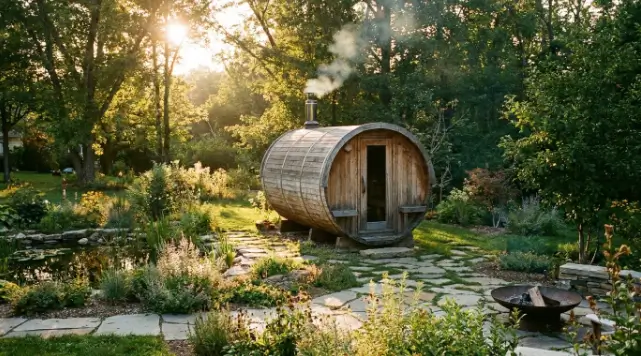
Winter is when a barrel sauna earns its keep the most, for five practical reasons: the temperature contrast feels sharper, the curved roof handles snow better than a flat-roofed structure, installation timing works in an owner’s favor, usage tends to go up rather than down, and the cold-to-hot routine pairs naturally with the season people already associate with staying indoors. None of this requires special winter-only equipment, just an understanding of why the coldest months are when a barrel sauna gets used the most.
1. The Temperature Contrast Is Sharper
Stepping from 20 degree outdoor air into a barrel holding 170 or 180 degrees is a far more dramatic sensation than the same transition on a mild fall evening. Many owners describe this contrast as the actual draw of sauna use, more than the heat alone. It also makes a quick roll in the snow or a short stint in a cold plunge feel like a natural extension of the routine rather than an extra step, since the ambient temperature is already doing half the work.
2. The Curved Roof Sheds Snow the Way It Sheds Rain
A barrel’s rounded roof is built to shed water off both sides, and that same shape handles snow load better than a flat or low-pitched roof would. Snow tends to slide off rather than accumulate in a deep, heavy layer, which reduces the structural stress a cabin-style sauna with a flatter roof might face after a heavy storm. Clearing a barrel roof occasionally after major accumulation is still a reasonable habit, but it is far less of a concern than it would be with flat-roof outdoor structures.
3. Installation Timing Works in an Owner’s Favor
Ordering in late fall means a barrel sauna typically arrives right as the weather turns cold enough to want it most. As long as the ground is not frozen solid, leveling a gravel or block base is still workable in early winter in most climates, and getting the unit set up before the coldest stretch means it is ready to use exactly when the appeal is highest, instead of sitting through an entire cold season waiting for a spring install.
4. Usage Tends to Go Up, Not Down
Counterintuitively, many owners report their heaviest use in winter rather than summer. A hot barrel in July competes with already-warm outdoor temperatures and can feel less appealing; the same barrel in January is the most comfortable place in the yard. Regular use is where a barrel sauna’s value actually shows up, and research on frequent sauna bathers, generally comparing weekly use against four to seven sessions a week, has found stronger associations with favorable cardiovascular markers at the higher frequency end. A season that naturally pushes usage up is doing some of that consistency work for an owner without any extra effort.
5. The Cold-to-Hot Routine Fits the Season Already
Winter is already a season built around contrast: cold mornings, warm homes, hot drinks. A barrel sauna slots into that pattern more naturally than it does into a summer routine built around already being outside in warm weather. For households that also use a cold plunge or simply step outside briefly between rounds, winter air does the cooling work that would otherwise require a chiller or an ice-filled tub, which is a real cost and equipment savings compared to trying to recreate that contrast in July.
What to Check Before Committing to a Winter Purchase
A heater sized correctly for the barrel’s interior matters more in winter than any other season, since it has to work against a bigger gap between outdoor and target temperature. An undersized heater that was merely slow in October can genuinely struggle to reach the top of its range on a 10 degree night. Before buying, check the heater wattage listed against the barrel’s interior volume rather than assuming a unit marketed as “cold climate ready” without a specific number behind it is actually sized for your region. Retailers such as Sweat Decks list wattage and interior dimensions together, which makes that comparison easier than guessing from marketing language alone.
How to Prep a Barrel Sauna for Its First Cold Season
A short pre-winter checklist saves real trouble later. Clear leaves and debris away from the base and any vent openings before the first hard freeze, since anything trapped against the barrel through a wet, cold stretch takes longer to dry out and can invite mildew once temperatures rise again in spring. Check the door seal for gaps, since a barrel that seals well in mild weather can develop a slight draft once wood contracts in dry winter air. Confirm the heater’s breaker and wiring were sized for continuous use, not just occasional summer sessions, since a unit that gets used more often in winter puts more real hours on the electrical system than a lightly used summer setup would.
A Realistic Winter Routine
Owners who use their barrel sauna heavily in winter often settle into a pattern of two or three evening sessions a week, sometimes more on weekends, with the sauna itself becoming something closer to a household fixture than a novelty. A typical evening might mean twenty minutes to heat from cold, then two or three rounds with a short stint outside in the cold air between each one. This pattern lines up reasonably well with the frequency ranges studied in sauna cohort research, where four to seven sessions a week showed the strongest associations with favorable cardiovascular markers compared with roughly once-weekly use, though again this is population-level association rather than a guarantee for any individual household.
Frequently Asked Questions
Does cold weather make a barrel sauna work better? The heat works the same regardless of season, but the contrast between hot interior and cold air is sharper in winter, which many owners find more satisfying.
Is a barrel sauna more expensive to run in winter? Heat-up takes a bit longer in freezing temperatures, but the difference is usually extra minutes, not a dramatic cost increase.
Can a barrel sauna be installed in winter? Yes, as long as the ground is not frozen too hard to level a base. Late fall or early winter delivery often means it is ready right as the coldest months arrive.
Does snow damage a barrel sauna roof? A properly built curved roof sheds snow well, similar to rain. Clearing heavy accumulation occasionally is still good practice.
Do people use their barrel sauna more in winter than summer? Many owners report winter as their heaviest-use season, since a hot barrel is most appealing exactly when it is coldest outside.
References
- Cardiovascular and Other Health Benefits of Sauna Bathing: A Review of the Evidence, Mayo Clinic Proceedings, 2018
- Clinical Effects of Regular Dry Sauna Bathing: A Systematic Review, Evidence-Based Complementary and Alternative Medicine, 2018
- Effects of heat and cold on health, with special reference to Finnish sauna bathing, American Journal of Physiology, 2018
By Renee Castellano