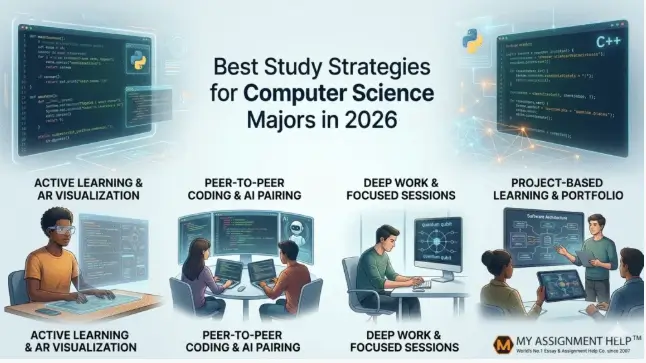
The landscape of computer science (CS) education has fundamentally shifted. In 2026, earning a CS degree is no longer just about memorizing syntax or passing calculus exams; it is about navigating an environment where AI pair-programmers write baseline code in seconds, and software architectures evolve rapidly.
Data from the Computing Research Association (CRA) indicates that while undergraduate enrollment remains resilient, the core competencies employers demand have transformed. Today’s tech industry prioritizes deep analytical problem-solving, architectural design, systems engineering, and the ability to audit and secure automated codebases.
To thrive under these conditions, students must move beyond outdated study routines. Passive reading and superficial cramming fail when applied to complex algorithmic reasoning and systems-level programming. Excelling in a modern computer science curriculum requires highly targeted, data-backed cognitive frameworks and practical learning strategies.
1. Shift from Passive Learning to Active Code Synthesis
Many students mistake reading a textbook or watching a lecture video for actual studying. In a technical discipline, cognitive retention is heavily dependent on active recall and kinesthetic execution (hands-on practice).
When you review data structures, do not simply look at a diagram of a binary search tree. Open an integrated development environment (IDE) and implement it from scratch without templates. Write the insertion, deletion, and traversal algorithms manually, and then force edge cases—such as balancing an asymmetrical tree or handling null inputs—to see where your logic breaks.
The reality of academic workloads means that complex programming assignments or theoretical proofs can occasionally stall your progress. If you find yourself conceptually stuck on intricate database normalization formulas or discrete math principles, leveraging professional, targeted computer science homework help can clarify underlying architectural patterns and prevent you from falling behind in dense syllabi.
2. Mastery Through Decomposition: The Feynman Technique
Computer science curricula are notorious for abstract bottlenecks, including concepts like asynchronous concurrency, dynamic programming, and compiler optimization. When a topic feels impenetrable, apply the Feynman Technique:
- Write down the concept name at the top of a blank page.
- Explain the concept in plain, non-technical terms as if teaching it to a complete novice. Avoid using industry jargon to mask gaps in your understanding.
- Identify the exact bottlenecks where your explanation falters or becomes vague.
- Return to the primary source material (documentation, academic papers, or lecture notes) to isolate and patch those specific gaps until the explanation is seamless.
For example, instead of defining a pointer as “a memory address variable,” explain it as “a sticky note that doesn’t hold data itself, but tells you exactly which locker contains the data.” If you cannot simplify the abstraction, you have not fully mastered the underlying architecture.
3. Leverage Spaced Repetition for Syntax and Theoretical Proofs
While deep conceptual design is critical, foundational knowledge—such as Big-O time complexities, network protocols, standard library methods, and discrete mathematical proofs—must be memorized for rapid deployment during exams and technical interviews.
Human memory decays exponentially along the Ebbinghaus Forgetting Curve. To counteract this, utilize spaced repetition systems (SRS) like Anki or SuperMemo. Rather than studying a deck of flashcards daily, SRS software uses algorithms to show you information precisely at the moment you are about to forget it.
Recommended Spaced Repetition Intervals for Technical Mastery
- Session 1 (Within 24 hours of lecture): Focus on core definitions and base syntax. The goal is to consolidate working memory.
- Session 2 (3 days after Session 1): Focus on Big-O bounds and algorithmic constraints. The goal is to identify edge cases.
- Session 3 (7 days after Session 2): Focus on implementation from memory without prompts. The goal is to transition information to long-term memory.
- Session 4 (14 days after Session 3): Focus on variations and real-world optimizations. The goal is to build flexible cognitive retrieval.
See also: Diversification Strategies in Crypto Investing
4. Treat Code Debugging as a Scientific Inquiry
Novice programmers often approach errors via “guess-and-check” debugging—changing lines of code at random until the compiler stops throwing errors. This is highly inefficient and fails to build engineering intuition.
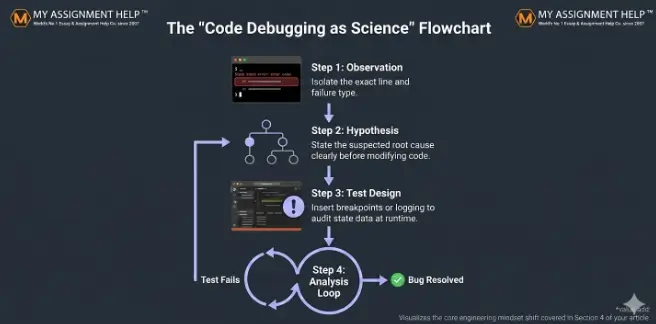
Instead, structure your debugging process like a formal scientific experiment:
- Observe the behavior: Note the exact error code, stack trace, or unintended logical output.
- Formulate a hypothesis: Based on the stack trace, isolate the specific module or memory block causing the failure. State clearly: “I believe this NullPointerException occurs because the array is not initialized before the loop executes.”
- Design a test: Use targeted print statements, assertion blocks, or a dedicated debugger tool (like GDB or LLDB) to inspect variables at that precise execution frame.
- Analyze and iterate: If the variable holds the expected value, reject your hypothesis and form a new one based on the fresh data points.
5. Build an Extracurricular Portfolio to Solidify Theory
A high GPA proves you can follow instructions; an open-source portfolio proves you can engineer solutions. Academic assignments often provide “clean” environments with pre-written boilerplate code. Real-world systems are messy, legacy-driven, and poorly documented.
Dedicate 3 to 5 hours a week to building personal projects or contributing to open-source software on platforms like GitHub. Apply classroom theories directly to these builds:
- Learning about relational databases? Design, normalize, and seed an SQL database for a local business.
- Studying computer networks? Write a basic HTTP server from scratch using raw sockets.
- Explored graph algorithms? Build a visualizer that maps out the shortest path through a custom web-scraped dataset.
Navigating the logistics of git branches, API rate limits, and asynchronous data pipelines will deepen your classroom comprehension far more than reading slide decks. If balancing high-level software builds with rigorous general education requirements becomes overwhelming, securing reliable assignment writing services for non-core courses can help preserve your mental bandwidth for deep-dive engineering work.
Key Takeaways
- Prioritize Active Coding Over Reading: True comprehension is built by manually coding algorithms and breaking them under stress, not by reviewing highlighted lecture notes.
- Structure the Debugging Process: Treat runtime and logical errors as scientific problems. Isolate variables systematically via step-by-step debugger tracing.
- Counteract Cognitive Decay: Implement a systematic spaced repetition framework to anchor syntax, proofs, and algorithmic complexities into long-term memory.
- Keep Theory Connected to Practice: Bridge the gap between abstract academic concepts and industrial engineering by building functional, open-source personal portfolios.
Frequently Asked Questions
How do I prepare effectively for a computer science exam?
Do not study by reading code samples. Instead, simulate the exact testing environment. If your exam is paper-based or uses a locked browser without an auto-complete feature, practice writing functional, syntax-accurate code on a whiteboard or a plain text editor without documentation access. Focus heavily on tracing variables through nested loops and recursive functions by hand.
What should I do if I experience severe coding burnout?
Burnout often occurs when you spend hours staring at a single logical bug without making analytical progress. Implement the 20-Minute Rule: if you are completely stuck on a single bug for twenty minutes, step away from the display. Walk, hydrate, or sketch the data pipeline on physical paper. Your brain continues processing the problem via the diffuse mode of thinking, often leading to a solution when you return.
How critical is mathematics to a computer science major?
Mathematics is the foundational bedrock of computer science. Fields like machine learning, computer graphics, cryptography, and algorithmic analysis depend heavily on linear algebra, calculus, probability, and discrete mathematics. Treat your math courses with the same tactical importance as your core programming classes.
Author Biography
Marcus Vance, MSE
Marcus Vance is a veteran software engineer and senior academic consultant at MyAssignmentHelp. He holds a Master of Science in Software Engineering from the University of Texas at Austin and spent over a decade architecting distributed systems for enterprise tech firms. Marcus specializes in making advanced data structures, algorithmic optimization, and backend infrastructure accessible to undergraduate computer science students through structured, evidence-based learning frameworks.
Academic Sources & Further Reading
- Computing Research Association (CRA): Annual Taulbee Survey on Undergraduate CS Enrollment and Curriculum Trends.
- National Center for Biotechnology Information (NCBI) / IEEE Transactions on Education: Studies on active recall, kinesthetic learning models, and cognitive load management in technical disciplines.
- The Ebbinghaus Forgetting Curve: Quantifying cognitive decay intervals for systematic spaced repetition designs.